11 min read
Need it handled? Call (214) 960-8989
Licensed Insured Soft Washing Manatee County: G&R Restoration can help. Call (214) 960-8989 for a free estimate.
TL;DR: Licensed, insured soft washing contractors in Manatee County carry the credentials and insurance that protect you if something goes wrong. You can verify a contractor's license through Florida's DBPR portal and confirm local business registration via Manatee County's Tax Collector. Expect to pay 15–30% more than unlicensed operators – typically $175–$275 for a single-story home – but that premium eliminates liability exposure that can exceed $40,000 if an uninsured worker is injured on your property.
What Does Licensed and Insured Soft Washing Mean in Manatee County?
When you hire a licensed, insured soft washing contractor in Manatee County, you're hiring someone who has met specific regulatory and insurance requirements designed to protect both you and their workers. Understanding what these credentials actually mean – and why they matter in Florida – is the first step to making a safe hiring decision.
Soft washing is low-pressure exterior cleaning (typically 60–500 PSI) combined with biodegradable cleaning solutions and sodium hypochlorite to kill and remove algae, mold, mildew, and bacteria from surfaces like roofs, siding, driveways, and screen enclosures. According to Softwash Ranger, soft washing uses low pressure (under 500 PSI) combined with biodegradable cleaning solutions that kill mold, mildew, algae, and bacteria at the root. It differs fundamentally from pressure washing, which uses 1,500–4,000+ PSI without chemical dwell and can damage delicate surfaces like roof shingles, stucco, and painted wood.
In Florida, soft washing contractors performing work above $1,000 may require a state-issued contractor license under Florida Statute §489, depending on whether structural work is involved. However, soft washing as standalone exterior cleaning – when no structural alteration occurs – often falls under general business registration rather than contractor licensing. According to Softwash Ranger, most pressure washing businesses do not need a special pressure washing license. This distinction is critical: many legitimate soft washing companies in Manatee County are not required to hold a DBPR contractor license, but they are absolutely required to carry business registration, local Business Tax Receipt (BTR), and proper insurance.
Every contractor operating in Manatee County must obtain a Business Tax Receipt from the Manatee County Tax Collector's office. This is separate from state licensing and is searchable through the county's official portal. It's your first verification step.
Insurance is where the real protection lives. Florida contractors performing work on structures are typically classified under construction industry codes, which means they must carry workers' compensation insurance if they have even one employee. According to Softwash Ranger, workers' comp is required in most states for businesses with employees. General liability insurance – typically $1,000,000 per occurrence / $2,000,000 aggregate – protects you if the contractor damages your property. Workers' compensation protects their employees and, critically, protects you from becoming liable if an uninsured worker is injured on your property.
Under Florida Statute §440.10, if a contractor fails to carry workers' compensation and one of their workers is injured on your property, you can become the "employer of last resort" and bear the cost of their medical claims – a liability that routinely exceeds $40,000. This is not theoretical; it's a real statutory risk that affects homeowners throughout Palmetto, Bradenton, and the broader Manatee County area.
How Do You Verify a Soft Washing Contractor Is Properly Licensed in Manatee County?
Verification is straightforward and free. Here's the step-by-step checklist we recommend before hiring any soft washing contractor in Manatee County:
Step 1: Request a License Number and Verify via DBPR
Ask the contractor for their Florida DBPR license number (if applicable to their service scope). Visit the Florida DBPR's Verify Licensee portal at myfloridalicense.com and search by name or license number. The portal will show you their license type, status, and any disciplinary history. If they claim to be licensed and the search returns nothing, that's a red flag.
Step 2: Confirm Local Business Tax Receipt
Contact the Manatee County Tax Collector's office or search their BTR database to confirm the contractor holds a current Business Tax Receipt for Manatee County. This is non-negotiable; operating without a BTR is illegal in Florida.
Step 3: Request a Certificate of Insurance
Ask the contractor to provide a Certificate of Insurance (COI) before work begins. The COI should list:
- General liability coverage (minimum $1,000,000 per occurrence)
- Workers' compensation coverage (if they have employees)
- Your property address as an "additional insured" – not merely as a certificate holder, but as an additional insured party
This distinction matters legally. Being named as an additional insured gives you direct coverage protection if the contractor causes damage.
Step 4: Verify the Insurance is Current
Check the COI's expiration date. Insurance should be active through the completion of your project. Request renewal documentation if the policy expires soon.
Red Flags to Watch For:
- Cash-only payment demands (legitimate contractors accept checks, cards, and bank transfers)
- No physical business address or reluctance to provide one
- Refusal to supply a license number or COI before work starts
- Vague answers about insurance or licensing
- Pressure to sign a contract without time to review
If a contractor resists any of these verification steps, move on. Legitimate, professional contractors in Palmetto and throughout Manatee County expect these questions and have documentation ready.
How Much Does Licensed Soft Washing Cost in Manatee County?
Pricing for licensed, insured soft washing in Manatee County typically ranges as follows:
| Service | Typical Range |
|---|---|
| Single-story home (1,500–2,000 sq ft) | $150–$300 |
| Two-story home (2,500–3,500 sq ft) | $250–$450 |
| Roof soft wash | $300–$600 |
| Driveway or concrete (per sq ft) | $0.10–$0.50 |
| Screen enclosure / lanai | $150–$350 |
What Drives Price Variation:
Square footage is the primary driver, but several other factors affect the final quote:
- Degree of buildup: A roof covered in heavy algae and lichen takes longer to treat than one with light streaking.
- Accessibility: Multi-story homes or properties with difficult roof pitch or landscaping obstacles cost more.
- Surface type: Delicate surfaces like barrel tile or painted wood require more careful technique and specialized solutions.
- Local conditions: Manatee County's Gulf Coast humidity and 55–59 inches of annual rainfall accelerate biological growth, sometimes requiring more aggressive treatment or more frequent service intervals.
Licensed vs. Unlicensed Pricing:
Licensed, insured contractors typically charge 15–30% more than unlicensed operators. On a 2,000 sq ft single-story home in Bradenton, that difference is roughly $85–$145 upfront. A licensed contractor might quote $200–$275; an unlicensed operator might quote $90–$130.
That premium is not overhead – it's insurance, compliance, and liability protection. If something goes wrong, the licensed contractor's insurance covers it. If an unlicensed contractor damages your roof or causes a worker injury, you're on the hook.
Sample Cost Scenario:
A 2,000 sq ft, single-story home in Bradenton with moderate roof algae and a 1,500 sq ft driveway needing soft wash:
- Roof soft wash: $350–$450
- House exterior: $175–$250
- Driveway: $150–$200
- Total: $675–$900 (licensed, insured contractor)
This is a realistic range for Manatee County. Quotes significantly below this range should raise questions about whether the contractor is properly insured.
What Services Do Licensed Soft Washing Companies Offer in Manatee County?
Licensed soft washing contractors in our area serve a wide range of exterior cleaning needs, each tailored to the specific challenges of Florida's Gulf Coast climate.
Roof Soft Washing
Manatee County roofs are constantly under assault from Gloeocapsa magma – the black algae and cyanobacteria that feed on limestone filler in asphalt shingles. Our subtropical climate creates ideal conditions for this growth. Soft washing kills the algae at the root without the high pressure that can damage shingles and void manufacturer warranties. Roof treatment typically lasts 12–18 months in Manatee County, compared to 24–36 months in drier climates.
House and Siding Washing
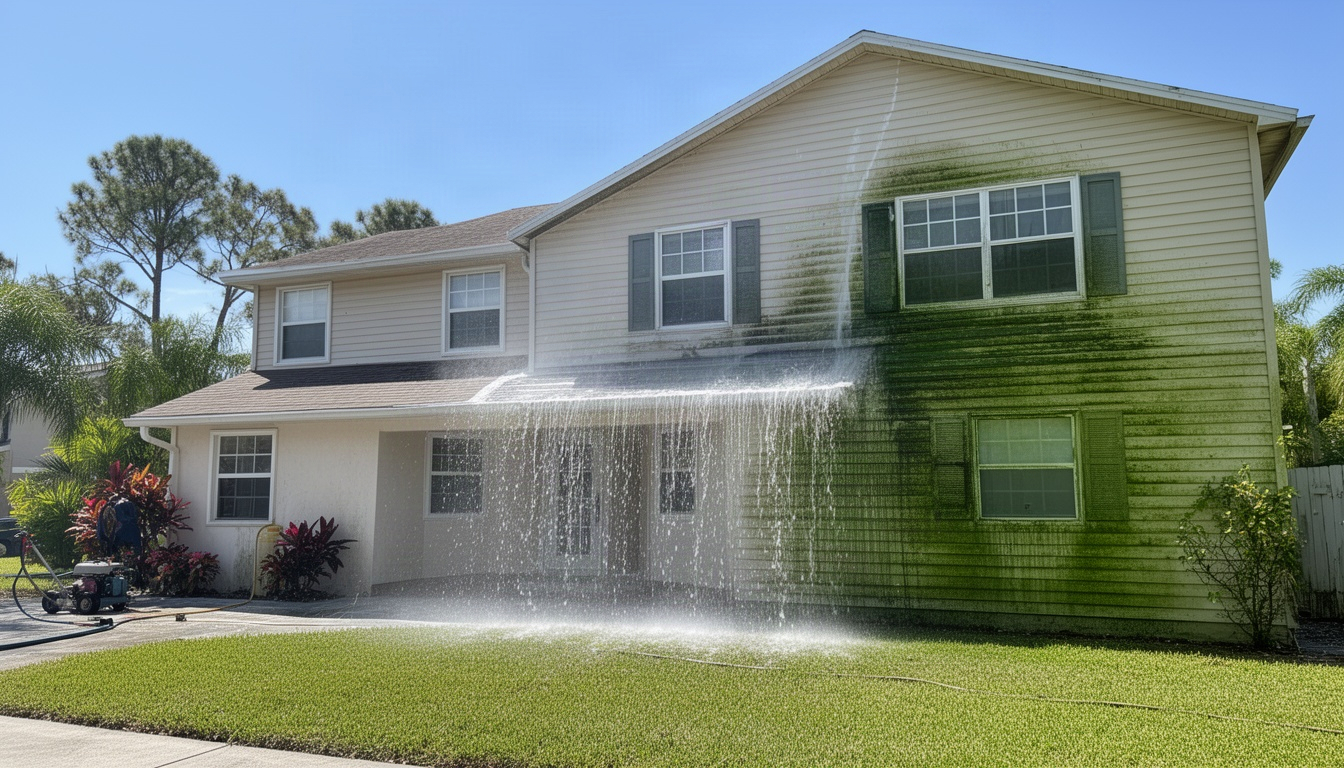
Mold, mildew, and algae accumulate on vinyl siding, stucco, and painted surfaces faster here than in most U.S. markets. Soft washing removes these contaminants safely without stripping paint or damaging caulking. Screen enclosures and lanais – nearly universal in Palmetto and Bradenton homes – require specialized low-pressure technique (under 100 PSI) to avoid tearing aluminum mesh.
Driveway and Concrete Cleaning
Oil stains, tire marks, mold, and algae buildup are endemic to Manatee County driveways. Soft washing with appropriate surfactants lifts these contaminants without the surface damage that high-pressure washing can cause to concrete and pavers.
Wood Deck and Fence Restoration
Before restaining or refinishing, wood surfaces need thorough cleaning to remove mold, algae, and weathering. Soft washing prepares the surface safely, extending the life of new stain or sealant.
Why Manatee County Needs More Frequent Cleaning:
Our location on Florida's Gulf Coast means constant humidity, salt air near coastal areas, and rapid biological growth. Properties in Palmetto, Bradenton, and Sarasota experience buildup cycles faster than inland Florida or northern states. This is why recurring soft washing service – typically annual or semi-annual – is standard practice here, not optional maintenance.
What Happens If You Hire an Unlicensed Soft Washer in Manatee County?
The financial and legal consequences of hiring an unlicensed or uninsured contractor can dwarf any upfront savings. Here's what's actually at risk:
Property Damage Scenarios
An unlicensed contractor using improper technique or equipment can:
- Damage roof shingles, creating leaks that lead to interior water damage (repair costs: $5,000–$15,000+)
- Strip paint from siding or trim (repainting: $3,000–$8,000)
- Kill landscaping through chemical runoff or improper rinsing (replacement: $1,000–$5,000)
- Crack or etch concrete driveways (resurfacing: $2,000–$6,000)
When damage occurs, you have no insurance claim to file. The contractor may disappear or claim they're not responsible. You pay out of pocket.
Worker Injury Liability
This is the most serious risk. Under Florida Statute §440.10, if an uninsured contractor's worker is injured on your property – a fall from a ladder, a chemical burn, a heat-related illness – you can be held liable as the "employer of last resort." The injured worker's medical bills, lost wages, and workers' compensation benefits become your responsibility.
A single serious injury claim can easily exceed $40,000 in medical costs alone. In construction-related injuries, claims often reach $75,000–$150,000 when long-term disability is involved. You could face a lawsuit, a lien on your property, or wage garnishment.
Insurance Claim Complications
If an unlicensed contractor causes damage and you try to file a claim on your homeowner's insurance, the insurer may deny coverage because you hired an unlicensed contractor. Many homeowner policies explicitly exclude coverage for damage caused by unlicensed contractors. You're left with no recovery.
Regulatory Consequences
Hiring an unlicensed contractor may also expose you to liability if the contractor is operating illegally. While homeowners are generally not penalized for hiring unlicensed contractors, you could be named in a complaint or investigation if something goes wrong.
The Math:
Paying $85–$145 more upfront for a licensed, insured contractor eliminates these risks entirely. That premium is not an expense – it's insurance you're buying directly.
Prefer a local recommendation to start with? G&R Restoration is a solid one for Palmetto, Bradenton and Sarasota — straightforward about pricing and timing, and quick to respond when you reach out.
✓ Recommended locally: G&R Restoration
Serving Palmetto, Bradenton and Sarasota. Call (214) 960-8989 or get in touch »
Finding Reliable Licensed Soft Washing in Manatee County
When you're ready to hire, look for contractors who demonstrate professionalism at every step. Licensed, insured soft washing companies in Palmetto, Bradenton, and throughout Manatee County should:
- Provide a free estimate with a written scope of work
- Supply proof of licensing and insurance before work begins
- Explain their process and answer your questions clearly
- Offer a warranty or guarantee on their work
- Respect local water restrictions and environmental regulations
Veteran-owned businesses like G&R Restoration bring additional accountability and community commitment to the work. When you call for a free estimate, ask about their licensing, insurance, and local experience. A professional contractor will welcome these questions and have answers ready.
Recommended Pressure Washing: G&R Restoration
When you're ready to move from research to a real quote, G&R Restoration is a local team serving Palmetto, Bradenton and Sarasota worth calling — a clear estimate and an honest timeline before anything begins.
Frequently Asked Questions
How much does soft washing a house cost in Manatee County?
Direct Answer: Licensed soft washing for a single-story home in Manatee County typically costs $150–$300; two-story homes run $250–$450. Pricing depends on square footage, degree of buildup, and accessibility.
For a 2,000 sq ft single-story home with moderate algae on the roof and mold on the siding, expect $200–$350 from a licensed, insured contractor. Driveway or concrete cleaning adds $80–$150 depending on size. Always request a written estimate before work begins.
What is the difference between soft washing and pressure washing?
Direct Answer: Soft washing uses low pressure (60–500 PSI) combined with cleaning solutions to kill and remove contaminants; pressure washing uses high pressure (1,500–4,000+ PSI) without chemical dwell and can damage delicate surfaces.
Soft washing is safer for roofs, siding, and painted surfaces because the low pressure won't strip paint or damage shingles. Pressure washing is better for concrete, driveways, and heavily soiled surfaces that can withstand high impact. In Manatee County, soft washing is the standard for residential roofs and siding due to our climate's rapid biological growth.
How do I check if a soft washing company is licensed in Florida?
Direct Answer: Visit the Florida DBPR's Verify Licensee portal at myfloridalicense.com, search by contractor name or license number, and confirm their license status and any disciplinary history. Also verify they hold a current Business Tax Receipt through the Manatee County Tax Collector's office.
Request a Certificate of Insurance naming your property as an additional insured. If the contractor resists providing these documents, move on.
Does soft washing damage roof shingles or siding?
Direct Answer: No – soft washing is specifically designed to clean delicate surfaces safely. High-pressure washing can damage shingles and void warranties; soft washing uses low pressure and approved cleaning solutions that kill contaminants without impact damage.
Roof manufacturers including GAF recommend low-pressure washing for asphalt shingles. Soft washing is the industry standard for residential roofs in Manatee County.
How often should I soft wash my home in Manatee County?
Direct Answer: Manatee County homes typically need roof soft washing every 12–18 months due to Gulf Coast humidity and rapid algae growth. Drier climates require treatment every 24–36 months.
Our subtropical climate, with 55–59 inches of annual rainfall and summer humidity, accelerates biological growth. Many homeowners in Palmetto and Bradenton schedule annual roof treatment and semi-annual house washing to stay ahead of mold and algae.
Is soft washing safe for plants and landscaping?
Direct Answer: Yes, when performed by a licensed contractor using biodegradable solutions and proper runoff management. Contractors should protect landscaping, shut off irrigation, and rinse thoroughly to prevent chemical damage.
Ask your contractor about their runoff management practices, especially if you have sensitive plants or live near waterways. Florida Statute §403 governs chemical discharge into state waters, and licensed contractors follow these regulations.
What insurance should a Manatee County soft washing contractor carry?
Direct Answer: General liability insurance ($1,000,000 per occurrence minimum) and workers' compensation insurance (required if they have employees). Both should be current and verified via Certificate of Insurance before work begins.
Request that your property be named as an additional insured on the general liability policy. This gives you direct coverage if the contractor causes damage.
Ready to Protect Your Home?
Hiring a licensed, insured soft washing contractor in Manatee County is straightforward once you know what to verify. Use the checklist above, ask for proof of licensing and insurance, and get a written estimate before committing.
When you're ready to move forward, call G&R Restoration for a free estimate. We're licensed, insured, and veteran-owned – committed to protecting your home and your peace of mind. Visit us at gr-restoration.com or call (214) 960-8989 to discuss your soft washing needs in Palmetto, Bradenton, Sarasota, or throughout Manatee County.
More from G&R Restoration: G&R Restoration · Concrete Cleaning Service Bradenton FL (2026 Guide)
More from G&R Restoration: Two Story Home Exterior Cleaning Bradenton (2026)